Beyond Gran Torino and Asian Males in Media

So...Bee Vang.

If you don't know him, then it's probably good to know who he is.

If you can know who Clint Eastwood is, you should definitely take time to know Bee Vang. Bee Vang was Clint Eastwood's co-star in Gran Torino.

I wrote a kind of synopsis of Bee and his experience making the film on my "ideas" AMMMO blog. Clint Eastwood included.

Bee Vang's a cool kid. It was at once surprising and refreshing to hear him spit hot fire on topics of race, masculinity, and media activism, ultimately deconstructing a movie that he played the lead role in.

Gran Torino was just one in a line of big Hollywood movies that have either ignored, impersonalized, de-masculinized, taken away the agency of the Asian male. Avatar: The Last Airbender directed by M.Night Shyalaman was based heavily on Chinese culture. However, the lead characters were three white actors, leaving Asian faces to provide the background. The movie so blatantly erased Asian culture and identity that it sparked the website racebending.com.

21 the movie was based on the life of mostly Asian MIT students who learned how to beat the Vegas tables using an intricate card counting system. The main guy was based on Jeff Ma, a kid who grew up in Massachusetts. His was centered around his circle of friends who were mostly Asian. However, in the production of the movie, the lead roles, went to London-based actor Jim Sturgess, a white guy and Kate Bosworth, a woman whiter than a New England winter.

So the question brought up by those two movies: Why would they cast white people in stories?

Simple! Because Asian characters wouldn't generate revenue, say studio executives. And that's the bottomline!

Unfortunately, the bottomline more often than not leads to less-than-ideal results, particularly if you're interested in representations of reality. It seems like a story's reality is represented to the extent that it doesn't interfere with making money, especially in Hollywood. The priority seems to be based on doing anything that gets people excited enough to fork over 10 bucks to earn the privilege of staring at 50 foot screen for 2 hours.

And unfortunately, movies can influence thinking and stereotypes about groups of people.

However, it is an accepted common practice to deny that you would let a movie influence your thinking.

The Asian Male in the Media and the Implications of it

The workshop held be Bee and Professor Schein, organized by Prof Scott Wilson, for me was pretty much the affirmation of a lifelong narrative of feeling invisible and insignificant. I mean, I don't suddenly need all this importance placed upon me, but it's nice to be acknowledged instead of categorically dismissed.

I wrote about how the only time I remember seeing a Filipino acknowledged in American media as a 9-year old was in an FBI warrant list. It was fascinating and scary at the same time, having someone who looked like he could be my uncle. I always wondered how mean the FBI dude actually was. I wrote about how the tide seems to be changing today and why Manny Pacquiao, the boxer is very important to a lot of us.

Now why is it important that Asian males have more representation in the media?

Well, I just kinda wish people would get used to the idea that we are subjects too, with emotions, opinions, ideas. My entire persona can't be dismissed just because I fit maybe a few characteristics of stereotypes.

I think the representations and stereotypes have a connection to the everyday decisions people will make about me: whether or not to engage in conversation with me to important things such as whether or not they will offer me a job. It's already been shown in sociological studies that a name that "sounds" black can be the basis of a systematic categorical dismissal of black job applicants. It's also been shown that faculty members described with stereotypically "woman" adjectives such as "nurturing", "kind", and "agreeable" got less faculty positions.

So we can make micro-decisions based on names and overly-simplified adjectives that conjure up stereotypes of identities. And they can affect not only my life, but a lot of people who fit into categories that are not at the top of the hierarchy.

Mistrust of Police and Ending Violence in One LA Community

(Cross-posted from my other site.)

Lot of thought-out ideas to ending violence in one LA community. The ideas came complete with definitive metaphors and punchlines about problems and solutions.

I noted a few of the comments that struck me.

One major theme of the meeting was a distrust of the police.

  • Perception of the Police: They viewed the police as employing strategies of suppression rather than intervention.
  • No personal connection with the police: One community member, a female, said that "there's no cop I know that I can call at 2 AM"
  • Another Perception: Police are just a "mop and broom." One community member said that the police Are a "Mop and Broom". "Mop and broom" is an interesting metaphor for law enforcement. The implied association of mop and broom is that of janitors who only come after a "mess" has been made. The suggestion is an indictment of their preventative measures (or lack thereof) to deter crime.
  • History of mistrust between community and police? In the past, when activists did work with the police, the police arrested people, and so people that are actually prone to violence are going to stay as far away as possible.
  • Misattribution of credit for the drop in crime. Community members from a youth group disliked how the various police departments in LA County took credit for the low numbers and drop in crime. They said that it was community work, the work of outreach, gang interventionists, and street workers that curbed crime. They gave these interventionists the title of "knowledge workers", championing the rationality, agency, and influence of these mostly-youth-aged individuals.
  • One way the police could help the community from one perspective: share their resources with youth. They're largely viewed as having too many resources at their disposal, especially in comparison with economic development and education.

They also talked about life in the neighborhood and criticized churches and the foster system:

  • Kids get robbed at gunpoint everyday. Can't imagine what psychological toll that takes.
  • Going to funerals is normal. Again can't imagine what psychological toll that takes.
  • One community member talked about having a large number of people who suffer from PTSD
  • The Foster system was viewed as something that "attacked" black families and lacked discipline in its approach.
  • Churches have been an important uniter of community. It's one place that I know police officers in the LAPD have outreached to as a way to say they outreached to the community. However, in this meeting, one community member said that the church never did anything liberating to outreach to her.
  • "It's all a slam" said a community member. Slam of the jail bars to the slam of the casket.

My own thoughts:

  • As an Anthropologist interested in Victor Turner's work on symbolism and rituals, I'd been thinking about how quickly people act on symbols in gang life; wear the wrong color, be from the wrong crew, you're likely to get shot, even if your identity might be mistaken.
  • They talked a lot about changing the mindsets and cultures of gang members who perpetuated a majority of the violence. "Cultures" is always a buzzword for this Anthropologist, and I think we can participate in culture change. As far as carrying out change in the community, it can be sort of presumptuous of me, this coddled, comfortable, paraprofessional grad student. However, I have had the benefit of looking at tons of patterns throughout many disciplines and I can offer some synthesis of ideas from my experiences. That said, I've seen a lot of movements for change build momentum and lose it. I think part of it has to do with a feeling of "ownership" of a movement. Ownership is deeply personal, a "braiding" of the movement/cause with one's identity. You live, eat, breathe something. Who is going to step up, and make it their "own?" I think people rarely take on a full "ownership" and are prone to consumption. They'll support going to a few things, sign postcards, talking about it, but they won't do the logistics of phone banking, organizing rallies, getting permits, etc. I was just wondering how we facilitate an advantage to taking care of such logistics that are important for a movement without making it a paying job.

Math and Science Education and Inspiration

So Paulo Freire, champion of liberating education was brought back into my consciousness on this New Years Day.

He was brought to my attention via the mega Anthro Listserv.

Freire is the man who wrote Pedagogy of the Oppressed. Pedagogy of the Oppressed was something I'd never read in its entirety and read within the contexts of Education classes. I thought its ideas essential models to inspiring a thirst for learning and freedom in students.

The Listserv posting wasn't about Freire himself, but about how a tenured professor of physics named Denis Rancourt took Freire's Pedagogy of the Oppressed and applied it to his own class. One of the manifestations of the Freire's ideas is to place minimal importance on grades. One way Rancourt dealt with that? He gave all his students A+s. Why? He explains on his website:
With grades students learn to guess the professor's mind and to obey. It is a very sophisticated machinery, whereby the natural desire to learn, the intrinsic motivation to want to learn something because you are interested in the thing itself, is destroyed. Grades are the carrot and stick that shape obedient employees and that prepare students for the higher level indoctrinations of graduate and professional schools. The only way to develop independent thinking in the classroom is to give freedom, to break the power relationship by removing the instrument of power.
The fact that he gave everyone A+s pissed people off and led to his firing.

Why do I bring this up?

Well, the fact that a Physics professor in the "hardest" of sciences hit home with me. I'd experienced the sciences and math in a very negative way throughout my educational experience, and it all had to due with grades, or my sudden inability after high school to get good ones in those subjects.

Throughout undergrad, I more or less avoided sciences and math outside my requirements. I instead took Science as Culture and ended up taking a plethora of History of Science classes, eventually getting a Minor in it.

I've become interested in all kinds of ideas from philosophy to math, all of which I believe dovetails beautifully into the broadness of Anthropology, however, I find myself a bit behind and struggling mightily to pick up where my high school math and science abilities left off, now almost 9 years ago.

Needless to say I wish there were more Denis Rancourts so I could just focus on understanding permutations, probabilities, and/or calculus... as their very own language and symbol systems.

AGSA Amish Themed Potluck & Movie Night

My plate of awesomeness! Sharon's Shoofly pie, my quinoa dish, and Maral's Amish broccoli casserole. YUM!
Brian liked it too :)
The broccoli casserole


There weren’t too many of us at the AGSA movie night but it was fun anyways! We watched the movie Devil’s Playground about Amish teenagers who go out into the “English” world before deciding whether or not to join the church. So with that, we decided to have an Amish themed potluck and yes, it was delicious. It was a really interesting movie to watch because the stories of Amish reflected so many stories that anthropologists hear from people about why they do what they do. Maral made a great point about how they reflect a lot of the same stories of other immigrant groups that aren't always completely understood or accepted for whatever reason. I think there need to be more movie nights in the future!

An Answer to the Why Anthropology Question

I read Didier Fassin's When Bodies Remember about AIDS in South Africa last year. Didier Fassin is a converted Anthropologist from the Insitute of Advanced Study affiliated with Princeton and was previously a doctor for Doctors Without Borders.

I read the book because someone somewhere promised that it would broach the topics of memory, bodies, and metaphors, all topics that tickle my funny bone.

So most of what I found in his book did just that for those topics. I took some notes on my twitter around September 9, 2009.

Anyhow, the dude is getting love from...drumroll please...New Jersey press.

OK, OK, some Anthropologist getting local press and love from the triple A is not really why this is important.

What's important is his explanation of why he got into Anthropology in the first place, transitioning from being a Doctor.

From NJ.com via the Triple A Twitter

The question of how ethically any superpower intervenes — how it manages the politics and inequality of that relationship — is the work that absorbs Professor Didier Fassin.

The James D. Wolfensohn Professor at the Institute for Advanced Study here, Fassin is a medical doctor turned anthropologist turned philosophical gadfly, all in the service of insisting that the right questions be asked when one country storms into another with planeloads of food or soldiers.

“This is not meant to be a critique from the outside, but really trying to get inside the logic of humanitarianism to see what is gained and what is lost when a country does this,” Fassin, 55, said during an interview at his Institute office last week. “What are the impasses or the ambivalence that you bring to that situation?

“It’s not rejecting humanitarian action, it’s bringing the voice of the people, it’s being concerned with their identity and not avoiding the question of social justice. These are not contradictory. In my work I’m not describing an ideal way of dealing with these problems but rather a more realistic way of looking at them.

“Bringing intelligibility to the world. This is really what anthropology is about.”

I wonder if he could come speak at our next Anthro grad meeting. : )

"Design Ethnography" and Sex

For those of us that had the Theory class with Scott Wilson, an article talking about "Design ethnography" from Psychology Today

One of the techniques that companies like Apple use to identify and develop hit products is called design ethnography. It's a powerful tool for building hit products. Design ethnography takes the position than human behavior and the ways in which people construct and make meaning of their worlds and their lives can be observed in such a way that unarticulated and tacit needs and desires can be uncovered.

For example, a watch designer understands that the human need for status is just as vital as the need to tell time. In a traditional product survey, the questions are all about function. But in an ethnographic expedition, the designer observes the wearer of the watch in the field; he gathers firsthand data about the subtle clues and emotions that the subject might reveal. Hence, design ethnographers can unlock powerful market opportunities by seeing beyond than what people say... to see how they feel but cannot express.

If we turn our attention to the institution of marriage, one common disagreement with older couples is the common argument over how much sex is enough...when you think like a design ethnographer, your job is to delve down below the superficial issues, where something profound can usually be unraveled.

Asian Americans are like homosexuals....

"Elite Asian Americans are like homosexuals in that their claims to moral citizenship rest not so much on suffering (thought that continues as they are targeted by hate crimes) but on the revelation of their important and diverse roles in a more complex American nation." - Aihwa Ong, Buddha Is Hiding

I LOL'ed at that. It's only a simily, but I don't know that for purposes of a public audience it was an association that "needed" to be made. As if Asian Americans need to be feminized some more.

The Cambodian Arts Exhibition in Photos

So, a few of us have this class called "Historical Ethnography." It was centered on putting on this exhibit, which happened just yesterday at a local park in Long Beach.

Results of the class are as follows:


See that label? They put us in charge of that!


Hean Pin, Kingpin of the Cambodian game, Sey


Graduate Students. In Long Beach.

Useful Links

Just also want to use this space to collect good links on Anthropology.

MIT has open courseware which has syllabi and readings from courses they offer.

An Anthropology listserv tends to blow up my inbox and sometimes the debates they engage in might actually be interesting

As from me, I've saved a bunch of stuff over the years:

We've got my wordpress site: www.gradschoolnotes.wordpress.com

My delicious site: www.delicious.com/bdelasa with tags such as Theory, Anthrodiscipline, Academia, Psychoanthro, Medanthro, and Humanevolution

My stuff from Google Reader: My Shared Items, My starred items, Anthropology and Sociology News, Anthropology Discipline, Anthropology Journals, Medical Anthropology

Justice for Filipino American Veterans

So...I just wanted to share with everyone an article I wrote about Filipino American veterans.

This past Veteran's Day, fellow graduate student Alex Montaces and I both attended a parade/march in Los Angeles on behalf of Filipino American Veterans from World War II. This is about the 12th year that they're having the March, and they've been organizing on behalf of these veterans for over 20 year.

Unlike the American world war Veterans, who received the benefits of the GI Bill, went on to college, and bought houses and made their way up to the middle-classes, a lot of these vets are now in their 90s, US citizens, still pretty piss poor, and have been granted piecemeal benefits.

Last year, Obama's bill included a bill that would give US-based Filipino American veterans a one-time lump sum of $15,000, while those elsewhere would receive $9,000.

Filipino American Veterans were promised citizenship and benefits similar to the American soldiers in 1941. This was to help squeeze Japan. In 1946, congress decided that it would be "impractical" to pay the 250,000 Filiipino soldiers.

And so the veterans have been fighting for ever since 1946.

Transcriptions and Pain

Trying to get through my first round of transcriptions.

I was warned that for every hour I had on tape, there would be an additional 3 hours transcribing.

Currently, I am barely 45 seconds into a 26-minute tape. I am already annoyed at how I sound, the low quality sound I got, and various questions I couldn't think to follow up on.

Mostly annoyed at the low quality sound. Mine is a $60 Olympus recorder with a USB. I had a microphone, but I think the microphone may have just fubared the quality of recording. I can barely hear anything, and I'm having to go back and forth 6-7 times to get a word.

It didn't help that he kind of didn't speak into the microphone.

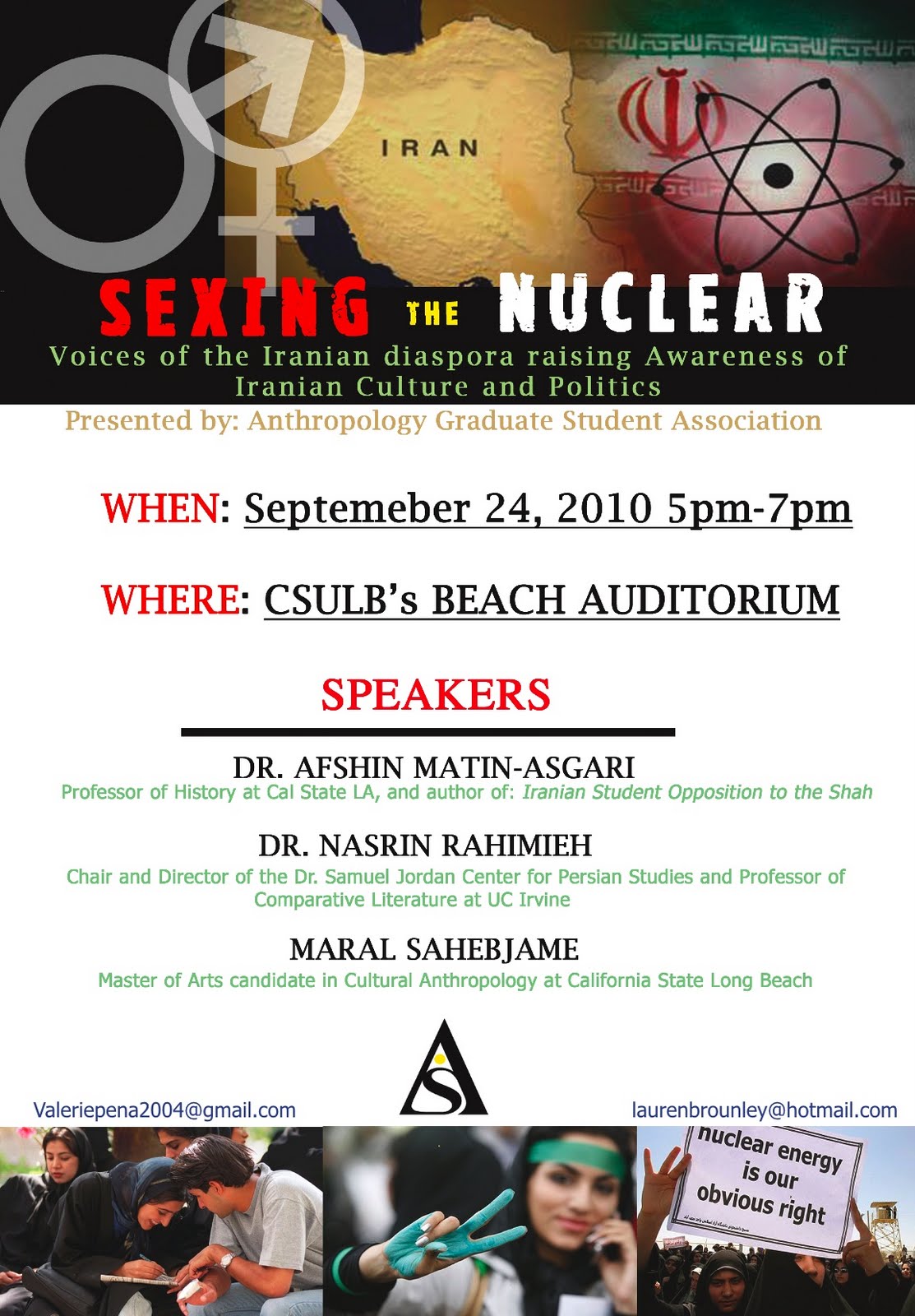
Iranian Speaker Series


This event turned out to be a really interesting and informative panel. The speakers all highlighted different aspects of Iranian life including the past & current political atmosphere, the diaspora to Southern California, and marriage practices & opinions among Iranian young adults. I hope we can do more informative panels in the future! It's a great way to spread knowledge and discuss what's really going on in places where our news media tends to provide slanted views. Furthermore, it shows how anthropological research can be used and shared in a variety of different contexts.
The panel getting ready to speak....

From left to right: Dr. Matin-Asgari, professor of history at CSULA; Maral Sahebjame, an M.A. student in our program and member of AGSA who just finished doing her research in Iran over the summer; and Dr. Rahimieh, professor of comparative literature at UCI. She is also the Chair and Director of the Dr. Samuel Jordan Center for Persian Studies.

Southwestern Anthropological Association

Call for Papers

Health and the Human Body: Practices, Policies and Perspectives

82nd Annual Conference ⦁ University of Nevada-Reno

May 5-8, 2011

The Southwestern Anthropological Association (SWAA) invites papers, posters, organized sessions, films, and panel discussions that engage with concepts of health, the body, medical practices, concepts of medicine, the biological evolution of humans, and the social and governmental policies that shape and often determine access to health care and concepts of what is healthy.

We encourage submissions from within and across all sub-disciplines: sociocultural, biological, linguistic, and archaeological; from all areas of the field: research, pedagogic, and applied.

The World Health Organization has stated that health is “a resource for everyday life, not the objective of living. Health is a positive concept emphasizing social and personal resources, as well as physical capacities.” According to this definition, physical, mental, and social well-being all play a role in health, particularly as we see it in the Western world.

As we become more firmly planted in the 21st century, notions of health and the human body are constantly changing due to impacts from other philosophies, cultures, and an increasing understanding of human biology. Additionally, healthcare services and access to them are seen as a fourth pillar of human health as it is through these services that the advancements and application of the health sciences can be offered to the general public.

We seek submissions that examine the impact of these four pillars of health, evaluate them, and explore those institutions that attempt to define health and the human body from varied cultural, historical, and evolutionary perspectives.

We invite submissions from our colleagues outside of the academy, including museum professionals, cultural resource managers, public health officials, and wellness professionals who can comment on the state of health care, historical populations and health, and non-Western concepts of health and the body.

Deadline for Submissions: February 1, 2011

For more information about SWAA, visit http://www.csus.edu/org/swaa/index.html

Exhibitors, vendors, and presenters should direct queries about the annual conference to:

Beth Townsend, Ph.D., President, Southwestern Anthropological Association

Department of Anatomy⦁ Arizona College of Osteopathic Medicine⦁ Midwestern University

Glendale, AZ, 85308

E-mail: btowns@midwestern.edu

Banquet Speaker: Dr. Daniel Cook, Assistant Professor

School of Community Health Sciences ⦁ University of Nevada-Reno

Women and Math

Yesterday during class, we had a tangential discussion about gender and math, basically why there aren't too many females getting into engineering, "hard" sciences, and da maths.

From years of internets reading when I wasn't necessarily "looking" for such information, I've found the following food for thought:

1) So one study says there's a correlation between how much dad and mom push stereotypes on their girl.

A longitudinal study out of the University of Michigan said that if a father held on to "traditional" gender stereotypes, that females were less likely to go into a math-related profession. From the website:

They found that parents provided more math-supportive environments for their sons than for their daughters, including buying more math and science toys for the boys. They also spent more time on math and science activities with their sons than with their daughters.

Davis-Kean and colleagues, including the late Janis Jacobs of Pennsylvania State University, Martha Bleeker of Mathematica Policy Research, Inc., and U-M psychologists Jacquelynne Eccles and Oksana Malanchuk, also found that parents' attitudes, particularly stereotypes they hold about whether math and science are more important for boys than for girls, have a significant effect on their children's later math achievement, and even on their eventual career choices.

They found that girls' interest in math decreases as their fathers' gender stereotypes increase, whereas boys' interest in math increases as their fathers' gender stereotypes increase.

"Fathers' gender stereotypes are very important in supporting—or in undermining—daughters' choices to pursue training in math and science," Davis-Kean said.


2) One psychology study from PNAS (irony in too many ways), said that elementary female teachers' math anxiety transfers over to their students.

Description from 80beats, Discover Magazine Blog:

The findings are the product of a year-long study on 17 first-and second-grade teachers and 52 boys and 65 girls who were their students [Science Daily]. Researchers recruited the female teachers from a Midwestern school district and assessed their level of math anxiety. They also gave math tests to 117 of these teachers’ students and jotted down their beliefs about math and gender at the beginning and end of the year. By the end of the year, the more anxious teachers were about their own math skills, the more likely their female students – but not the boys – were to agree that “boys are good at math and girls are good at reading” [AP].


3) Another psychological PNAS study found that countries with better gender equality, girls performed as well as boys on math tests.

Another description from 80beats:

They found that countries with poor gender equality, like India, had a larger gender gap in math, while in countries with excellent gender equality, like the Netherlands, girls performed as well as boys. If males really did have an innate advantage in math, the researchers note, that advantage should be obvious throughout all these cultures. Instead, the study suggests that cultural issues are the basis of the math gender gap.


4) Not a study, but teacher's experience in the culture of Mathematics:

The crucial difference of mathematics from many other walks of life is that its power games are deeply personal in the purest possible sense. To recognize someone as a fellow mathematician means to accept that she is intellectually equal (or even superior) to you and that she has the right to wear, like knight’s armor, her aura of intellectual confidence and independence. Too many men will still feel uncomfortable with that.

In that entry, she also cited and criticized this idea that women think more "collaboratively" as opposed to "independently." That made me think of why minority groups in general, whether racial, ethnic, religious, sexual, seem to always be described as more "collaborative."

5) Finally, the blog Sociological Images, run by two Sociology professors found the following and summarized some more findings:

And, since girls often outperform boys in a practical setting, math aptitude (even measured at the levels of outstanding instead of average performance) doesn’t explain sex disparities in science careers (most of which, incidentally, only require you to be pretty good at math, as opposed to wildly genius at it). In any case, scoring high in math is only loosely related to who opts for a scientific career, especially for girls. Many high scoring girls don’t go into science, and many poor scoring boys do.
In Japan, though girls perform less well than the boys, they generally outperform U.S. boys considerably. So finding that boys outperform girls within a country does not mean that boys outperform girls across all countries.

Filipino American History Month is October in California

Once upon a time during undergrad, I wanted nothing to do with other Filipinos or Filipino-Americans. I just wanted to be who I was without racial politics. And yeah, I want that to some extent, the part where there's no politics or fighting.

However, a few history of consciousness classes, an Anthropology degree later, and finding a source of social connection, here I am blogging about "Filipino American History Month."

LA County officially declared October, Filipino American History Month.


In Long Beach, the main library will feature an exhibit on Filipinos in World War II.

Here's a list of events, particular to Long Beach:

1) A film about a popular hip-hop artist and how he uses hip-hop as a tool in activism.

Sounds of a New Hope
featuring Shining Sons & Krystle Tugadi
Tuesday October 12, 2010
7:00pm - 9:30pm
Cal State Long Beach
University Student Union
Beach Ballroom
1250 Bellflower Blvd.
Long Beach, CA 90840

From the website:

"Sounds of a New Hope" is a documentary film about the life of Filipino-American MC Kiwi and the growing use of hip-hop as an organizing tool in the people's movement for national liberation and democracy in the Philippines."


2)

Book Talk, A 30-minute Movie and Book signing

Saturday, October 16, 2010
2:30-4:30 p.m.
Long Beach Main Library Conference Room

From the website:

There will be a 30-minute movie that will be shown about the Battle of Manila, made by the U.S. Army Signal Corps for release to movie theaters. It was believed that Gen MacArthur did not allow it to be shown publicly because the war had already ended by the time that the film was ready for showing, and thus, few people had actually seen it. It was hidden away in the National Archives until a researcher found it 5 or 6 years ago."

More events in Long Beach and LA:

http://www.lbfilamevents.org/
http://www.fanhsla.org/

Checking the Organizing Committee Page:

Our very own Leticia Montoya gets a shout out!


If I may make additional comments:

A mixed race Chinese-Jewish female who was an Asian-American Studies major at UCLA always made the point about how in ethnic studies discourses, while there was a lot of focus given to immigrants and their migrational histories, there was scant attention given to the children of those immigrants, the 2nd generation and beyond. Basically people like her and me.

Other than that film featuring a popular rapper in the Fil-Am community, it still seems like that's the paradigm. My devil's advocate response to her was that "our" generations are still too new and when we get into more influential positions, perhaps that focus will change as well.

Ciclavia Coming to LA

Having been a bicyclist the past year, having an "in" into the bicycle advocacy world, and having been interested in public space and the broader field of urban planning since undergrad, here's a cool event happening this Sunday, October 10 or 10/10/10 at 10 AM in Los Angeles: CicLAvia!


From the website:
Inspired by CiclovĂ­a, the original, weekly street closure event in Bogotá, Colombia, CicLAvia opens LA streets to pedestrians and bicyclists, creating a temporary web of public space on which residents of Los Angeles can walk, bike, socialize, celebrate and learn more about their own city. On 10/10/10, 7.5 miles of roadways will temporarily close to car traffic and open for recreational purposes. From Boyle Heights to Downtown, MacArthur Park to East Hollywood, CicLAvia encourages Angelenos to not only make active use of their streets, but to rediscover the roadways and neighborhoods that too often go unnoticed in a car. Help open LA’s streets… take part in the first ever CicLAvia on 10/10/10.
BTW, also of note on their blog:

"Adonia Lugo is an anthropologist and PhD candidate at UC Irvine."

She is doing her project on bicycling advocacy and the concept of "body-machines." Talk to her, she can explain it. One of the things I talked to her about is how bicyclists feel more connection to a city than a driver. Bicyclists feel more "ownership" (not sure if that was her concept or mine) of a city than some person who zips past numerous landmarks, people, and things in the introverted, distancing pleasure box called their car.