Results of the class are as follows:

See that label? They put us in charge of that!


Hean Pin, Kingpin of the Cambodian game, Sey

Graduate Students. In Long Beach.
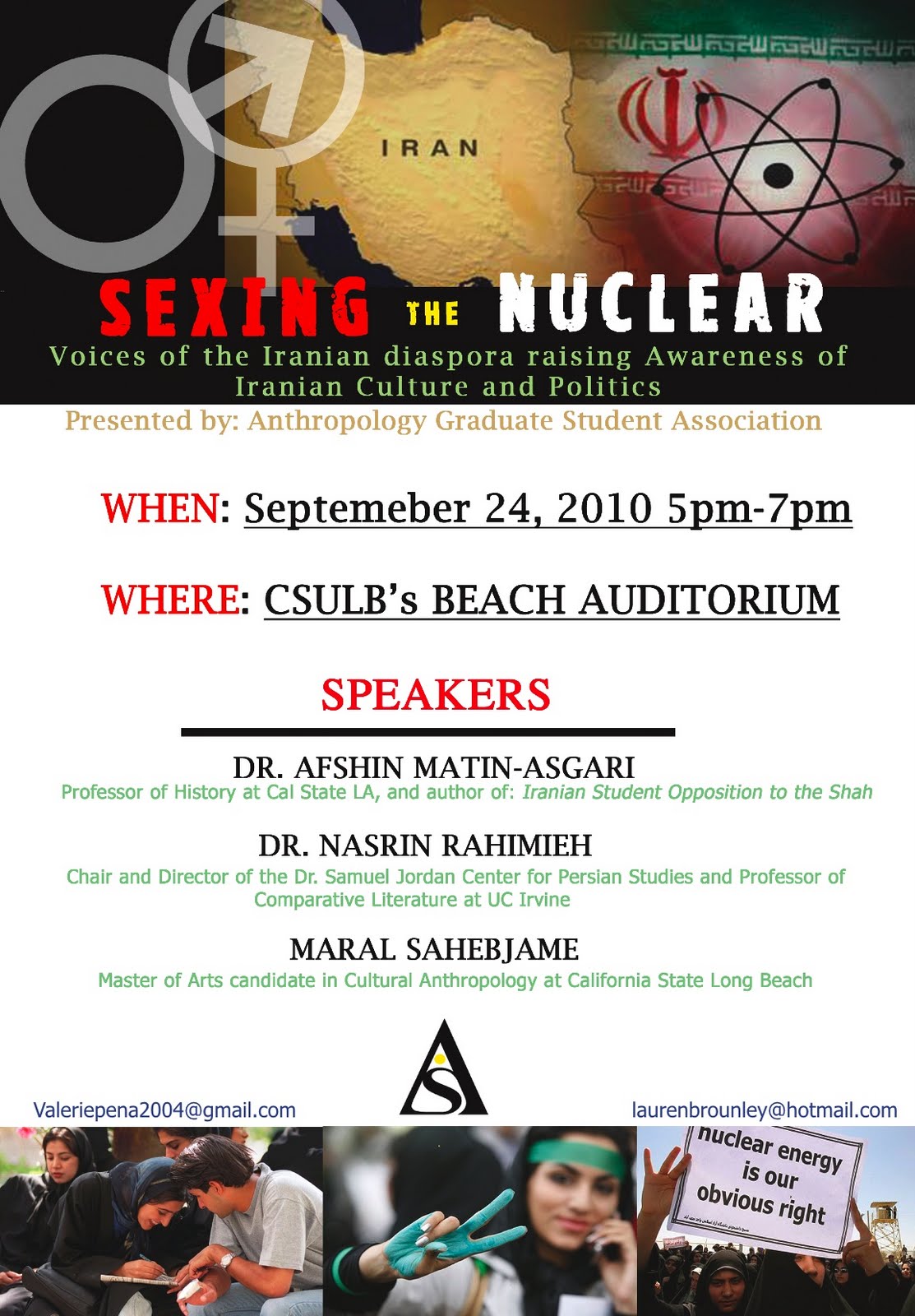
 The panel getting ready to speak....
 From left to right: Dr. Matin-Asgari, professor of history at CSULA; Maral Sahebjame, an M.A. student in our program and member of AGSA who just finished doing her research in Iran over the summer; and Dr. Rahimieh, professor of comparative literature at UCI. She is also the Chair and Director of the Dr. Samuel Jordan Center for Persian Studies.
Call for Papers
Health and the Human Body: Practices, Policies and Perspectives
82nd Annual Conference ⦁ University of Nevada-Reno
May 5-8, 2011
The Southwestern Anthropological Association (SWAA) invites papers, posters, organized sessions, films, and panel discussions that engage with concepts of health, the body, medical practices, concepts of medicine, the biological evolution of humans, and the social and governmental policies that shape and often determine access to health care and concepts of what is healthy.
We encourage submissions from within and across all sub-disciplines: sociocultural, biological, linguistic, and archaeological; from all areas of the field: research, pedagogic, and applied.
The World Health Organization has stated that health is “a resource for everyday life, not the objective of living. Health is a positive concept emphasizing social and personal resources, as well as physical capacities.” According to this definition, physical, mental, and social well-being all play a role in health, particularly as we see it in the Western world.
As we become more firmly planted in the 21st century, notions of health and the human body are constantly changing due to impacts from other philosophies, cultures, and an increasing understanding of human biology. Additionally, healthcare services and access to them are seen as a fourth pillar of human health as it is through these services that the advancements and application of the health sciences can be offered to the general public.
We seek submissions that examine the impact of these four pillars of health, evaluate them, and explore those institutions that attempt to define health and the human body from varied cultural, historical, and evolutionary perspectives.
We invite submissions from our colleagues outside of the academy, including museum professionals, cultural resource managers, public health officials, and wellness professionals who can comment on the state of health care, historical populations and health, and non-Western concepts of health and the body.
Deadline for Submissions: February 1, 2011
For more information about SWAA, visit http://www.csus.edu/org/swaa/
Exhibitors, vendors, and presenters should direct queries about the annual conference to:
Beth Townsend, Ph.D., President, Southwestern Anthropological Association
Department of Anatomy⦁ Arizona College of Osteopathic Medicine⦁ Midwestern University
Glendale, AZ, 85308
E-mail: btowns@midwestern.edu
Banquet Speaker: Dr. Daniel Cook, Assistant Professor
School of Community Health Sciences ⦁ University of Nevada-RenoThey found that parents provided more math-supportive environments for their sons than for their daughters, including buying more math and science toys for the boys. They also spent more time on math and science activities with their sons than with their daughters.
Davis-Kean and colleagues, including the late Janis Jacobs of Pennsylvania State University, Martha Bleeker of Mathematica Policy Research, Inc., and U-M psychologists Jacquelynne Eccles and Oksana Malanchuk, also found that parents' attitudes, particularly stereotypes they hold about whether math and science are more important for boys than for girls, have a significant effect on their children's later math achievement, and even on their eventual career choices.
They found that girls' interest in math decreases as their fathers' gender stereotypes increase, whereas boys' interest in math increases as their fathers' gender stereotypes increase.
"Fathers' gender stereotypes are very important in supporting—or in undermining—daughters' choices to pursue training in math and science," Davis-Kean said.
The findings are the product of a year-long study on 17 first-and second-grade teachers and 52 boys and 65 girls who were their students [Science Daily]. Researchers recruited the female teachers from a Midwestern school district and assessed their level of math anxiety. They also gave math tests to 117 of these teachers’ students and jotted down their beliefs about math and gender at the beginning and end of the year. By the end of the year, the more anxious teachers were about their own math skills, the more likely their female students – but not the boys – were to agree that “boys are good at math and girls are good at reading” [AP].
They found that countries with poor gender equality, like India, had a larger gender gap in math, while in countries with excellent gender equality, like the Netherlands, girls performed as well as boys. If males really did have an innate advantage in math, the researchers note, that advantage should be obvious throughout all these cultures. Instead, the study suggests that cultural issues are the basis of the math gender gap.
The crucial difference of mathematics from many other walks of life is that its power games are deeply personal in the purest possible sense. To recognize someone as a fellow mathematician means to accept that she is intellectually equal (or even superior) to you and that she has the right to wear, like knight’s armor, her aura of intellectual confidence and independence. Too many men will still feel uncomfortable with that.
And, since girls often outperform boys in a practical setting, math aptitude (even measured at the levels of outstanding instead of average performance) doesn’t explain sex disparities in science careers (most of which, incidentally, only require you to be pretty good at math, as opposed to wildly genius at it). In any case, scoring high in math is only loosely related to who opts for a scientific career, especially for girls. Many high scoring girls don’t go into science, and many poor scoring boys do.
In Japan, though girls perform less well than the boys, they generally outperform U.S. boys considerably. So finding that boys outperform girls within a country does not mean that boys outperform girls across all countries.
